

Seeing spots in your vision can have several causes, ranging from common eye floaters to conditions that require urgent medical attention.
Spots may appear as small specks or strands that move across your vision, as flashes of light, as shimmering areas, or as dark spots that remain in one place. The appearance of the spots, how suddenly they developed, and whether they affect one or both eyes can help determine what may be causing them.
A sudden onset of new spots or floaters should be taken seriously, particularly if you also experience flashes of light, blurred vision, loss of peripheral vision, or a dark curtain or shadow across your vision. These symptoms can be associated with a retinal tear or retinal detachment and require prompt evaluation.
If you experience these symptoms, call Barnet Dulaney Perkins Eye Center for emergency eye care at (602) 955-1000.
Do not schedule online for sudden spots, flashes, or significant changes in vision. Calling allows our care team to assess your symptoms and determine how quickly you should be evaluated. If you experience a severe or sudden change in vision after business hours, seek emergency medical care. Avoid driving yourself if your vision is significantly impaired.
What Does Seeing Spots Look Like?
People use the word “spots” to describe several different experiences:
- Small dots, specks, threads, or cobwebs that drift with eye movement
- Quick sparks or lightning-like flashes
- Shimmering, zigzag, or kaleidoscope-like patterns
- A hazy cloud or shower of tiny dark dots
- A fixed dark, blurry, or missing area
- A curtain, veil, or shadow across part of the visual field
These symptoms do not all come from the same condition. Some are common and may become less noticeable over time. Others require an urgent dilated eye examination.
Eye Floaters Are a Common Cause of Moving Spots

Floaters form inside the vitreous, the clear gel that fills much of the eye. Tiny clumps of gel or cells cast shadows on the retina, and those shadows appear as spots in your vision.
Floaters may be easier to see when looking at:
- A bright blue sky
- A white wall
- A computer screen
- A light-colored page
- A brightly lit room
Floaters become more common with age, especially as the vitreous changes and becomes more liquid. People who are very nearsighted, have diabetes, have experienced an eye injury, or have undergone eye surgery may also notice floaters more often.
Many established floaters are harmless. A sudden increase in new floaters is different and requires prompt evaluation.
Posterior Vitreous Detachment Can Cause New Floaters and Flashes
A posterior vitreous detachment, or PVD, occurs when the vitreous gel separates from the retina. This change becomes more common with age and may cause:
- A sudden new floater
- A ring-shaped floater
- A shower of small spots
- Flashes of light in the side vision
A PVD does not always damage the eye. However, the vitreous can sometimes pull hard enough to tear the retina as it separates.
An eye doctor needs to examine the peripheral retina to determine whether a new PVD has caused a retinal tear. You cannot make that distinction based on symptoms alone.
When Seeing Spots May Be an Eye Emergency

Call (602) 955-1000 immediately if you notice:
- Many new floaters are appearing suddenly
- Repeated flashes of light
- A dark curtain, veil, or shadow
- Sudden loss of side vision
- A rapid decrease in vision
- New floaters with blurry or distorted vision
- Spots after an eye injury
- New symptoms after eye surgery
- Eye pain, redness, and light sensitivity with vision changes
These symptoms require urgent evaluation.
Retinal Tears and Retinal Detachment
The retina is the light-sensitive tissue lining the back of the eye. A retinal tear develops when the vitreous pulls on the retina strongly enough to create an opening.
A tear may cause sudden floaters, flashes, or both. If fluid moves through the tear and separates the retina from the back of the eye, a retinal detachment can develop.
Possible retinal detachment symptoms include:
- A curtain or a shadow moving across vision
- Missing side vision
- Sudden blurry or distorted vision
- A large increase in floaters
- Frequent flashes
- Reduced central vision
Barnet Dulaney Perkins Eye Center provides retina care and evaluation for retinal detachment across Arizona.
Vitreous Hemorrhage Can Look Like Spots or Haze
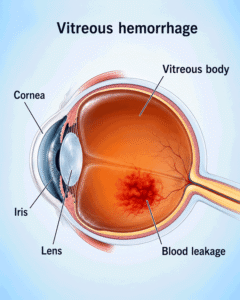
- Red or dark spots
- Cobwebs
- A cloud of tiny dots
- Hazy or smoky vision
- A sudden decrease in vision
Possible causes include diabetic eye disease, retinal tears, retinal blood vessel problems, trauma, and other retinal conditions.
A vitreous hemorrhage may be painless, but it still requires prompt examination. Blood can obscure the retina, making it difficult to determine whether a tear or detachment is present without diagnostic testing.
Migraine Aura Can Cause Shimmering Spots or Patterns
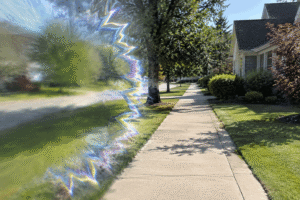
- Zigzag lines
- Shimmering lights
- Sparkles
- Colored shapes
- A growing blind spot
- Kaleidoscope-like patterns
A visual aura may occur before a migraine headache, during one, or without head pain. The pattern often develops gradually and changes over several minutes.
Migraine aura commonly affects the visual field of both eyes, even when it seems stronger on one side. Retinal problems more often affect one eye.
Covering one eye and then the other may help you describe the symptom, but it cannot safely diagnose the cause. A first-time aura, an unusual pattern, a fixed blind spot, or symptoms that do not resolve should receive medical evaluation.
Inflammation or Infection Inside the Eye
Inflammation inside the eye can release cells and debris into the vitreous, creating floaters or hazy vision.
Conditions such as uveitis may also cause:
- Eye redness
- Pain
- Light sensitivity
- Blurry vision
- Reduced vision
New spots accompanied by pain, redness, or sensitivity to light should not be dismissed as ordinary floaters.
Can Diabetes Cause Spots in Your Vision?
Diabetes can affect the small blood vessels in the retina. Diabetic retinopathy may cause bleeding, swelling, floaters, blurry vision, or areas of missing vision.
Some people with diabetic eye disease do not notice symptoms until the condition has progressed. Regular diabetic eye examinations help detect retinal changes before they cause noticeable vision loss.
People with diabetes should call promptly if they notice a sudden increase in spots, cloudy vision, flashes, or missing areas in their visual field.
Can Dry Eye Cause Spots?
Dry eye may cause fluctuating blur, glare, burning, or a filmy sensation. Blinking may temporarily clear the vision.
Dry eye generally does not create true floaters that drift inside the eye. Distinct moving specks, cobwebs, flashes, or a fixed dark area may point to a different cause.
An eye examination can help distinguish an ocular surface problem from a vitreous or retinal condition.
Why Do I See Spots After Looking at a Bright Light?
Looking at a bright light may leave a temporary afterimage. This can appear as a colored, bright, or dark spot that gradually fades.
Floaters also become easier to notice against bright backgrounds because their shadows have more contrast.
Avoid staring directly at the sun or other intense light sources. Seek prompt evaluation if a spot remains fixed, does not fade, or follows exposure to a laser or unusually bright light.

Treatment for Spots and Floaters
Treatment depends on the cause.
Long-standing floaters that do not affect daily activities may only require monitoring. They often become less noticeable as they settle or as the brain adapts to them.
A retinal tear may require laser treatment or another procedure to reduce the risk of detachment. A retinal detachment requires urgent retina care.
Inflammation, bleeding, migraine, diabetic eye disease, and other conditions require treatment directed at the underlying problem.
The first step is to identify the cause rather than assume every spot is harmless.
Get Urgent Help for New Spots or Flashes
A few familiar floaters may not signal a serious problem, but sudden or changing symptoms deserve immediate attention.
If you notice new spots, repeated flashes, sudden blurry vision, loss of side vision, or a curtain-like shadow, call Barnet Dulaney Perkins Eye Center emergency eye care at (602) 955-1000.
Do not schedule online for these symptoms. Call so the care team can direct you to the appropriate location and level of care. Emergency eye evaluations are available at select Arizona locations during business hours. If symptoms occur after hours, call 911 or go to the nearest emergency room.