
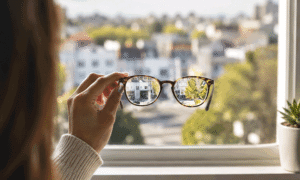
Blurry distance vision can make everyday life harder than it needs to be. Road signs may look unclear until you are close to them. You may squint to see a classroom board, a television screen, a menu above a counter, or faces across the room. For many people, those changes point to nearsightedness, also called myopia.
Nearsightedness happens when light focuses in front of the retina instead of directly on it. The result is that nearby objects may look clear while distant objects appear blurry
What Are the Symptoms of Nearsightedness?
Common myopia symptoms include:
- Blurry vision when looking at distant objects
- Squinting to see signs, screens, or faces far away
- Eye strain or headaches after trying to focus at a distance
- Difficulty seeing while driving, especially at night
- Sitting closer to the television or moving closer to the presentation screens
- A prescription that seems to change over time
A comprehensive eye exam can confirm whether myopia is causing your blurry distance vision. It can also help identify astigmatism, dry eye, cataracts, or other eye health concerns that may affect your vision and treatment options.
The Best Nearsightedness Treatment Options
Glasses For Nearsightedness
Glasses are often the simplest treatment option for nearsightedness. Prescription lenses help bend light so it focuses more accurately on the retina, which can make distance vision clearer.
Glasses work well for many children, teens, and adults because they are easy to update as prescriptions change. They can also be a good choice if you are not ready for contact lenses or vision correction surgery.
Contact Lenses For Nearsightedness
Contact lenses sit directly on the eye’s surface and correct distance vision without frames. Many patients like contact sports, exercise, travel, or everyday convenience.
Soft contact lenses are common, but some patients require specialty lens designs based on their prescription, corneal shape, or ocular surface health. If contacts feel dry, uncomfortable, or difficult to tolerate, your eye doctor can evaluate whether dry eye, allergies, fit issues, or another concern is causing the discomfort.
LASIK For Nearsightedness
LASIK eye surgery can reduce dependence on glasses or contacts for many adults with stable prescriptions and healthy corneas. During LASIK, a surgeon reshapes the cornea with laser technology so light focuses more clearly.
LASIK candidacy depends on more than your prescription. Your care team will evaluate corneal thickness, corneal shape, tear film, pupil size, eye health, and lifestyle. If you are interested in LASIK, a vision correction consultation can help determine whether you are a candidate.
PRK For Patients Who May Not Be LASIK Candidates
PRK is another laser vision correction option for nearsightedness. Like LASIK, PRK reshapes the cornea. Unlike LASIK, PRK does not involve creating a corneal flap.
That difference may make PRK a better fit for some patients with thinner corneas, certain lifestyle needs, or specific eye anatomy. PRK recovery usually takes longer than LASIK recovery, but it can offer a strong option when flap-based surgery is not ideal.
EVO ICL For Moderate To Higher Nearsightedness
EVO ICL is an implantable lens option for nearsightedness with or without astigmatism. The lens is placed inside the eye, behind the iris, and in front of the natural lens.
Unlike LASIK or PRK, EVO ICL does not remove corneal tissue. That can make it an option for some patients with higher prescriptions, thin corneas, or dry eye concerns. EVO ICL still requires careful testing because it is an intraocular procedure, meaning the lens is placed inside the eye.
Refractive Lens Exchange And Cataract Surgery
Refractive lens exchange may be an option for some adults seeking lens-based vision correction, especially when age-related near vision changes or early lens changes are part of the discussion. During RLE, the natural lens is replaced with an intraocular lens selected for your visual goals.
Cataract surgery is different. It treats a cloudy natural lens. If you have cataracts and nearsightedness, your surgeon can discuss lens options that may improve your vision after the cloudy lens is removed.
Nearsightedness Treatment for Children and Teens
Children and teens commonly develop nearsightedness as their eyes grow. Glasses and contact lenses can correct blurry distance vision, but a child’s prescription may continue changing over time.
Routine eye exams are important because children may not always recognize or explain that their distance vision has become blurry. They may sit closer to screens, struggle to see a board at school, squint often, or complain of headaches or eye strain.
LASIK, PRK, EVO ICL, and refractive lens exchange are generally adult vision correction discussions. Children and teens with worsening nearsightedness should have regular eye exams so their care team can monitor their vision and discuss appropriate next steps.
Comparing Nearsightedness Treatment Options
| Option | Best For | Things To Know |
|---|---|---|
| Glasses | Simple, flexible daily correction | Easy to update as prescriptions change |
| Contact lenses | Frame-free daily correction | Fit and eye surface health matter |
| LASIK | Many adults with stable prescriptions | Requires healthy corneas and full candidacy testing |
| PRK | Some patients who may not fit LASIK | Flap-free laser option with longer surface healing |
| EVO ICL | Moderate to higher myopia or thin corneas | An implantable lens is placed inside the eye |
| RLE | Some adults with lens-based vision needs | Replaces the natural lens with an IOL |
| Cataract surgery | Patients with cataracts | Lens selection may also address refractive goals |
Choosing The Right Option Starts With Testing
You do not need to choose on your own. A vision correction evaluation can compare your prescription, cornea, tear film, lens clarity, retina health, and lifestyle goals. Your doctor can explain which nearsightedness treatment options are available, which may not be a good fit, and what to expect regarding recovery, costs, and long-term care.
If you want clearer distance vision with less reliance on glasses or contacts, request a vision correction consultation with Barnet Dulaney Perkins Eye Center.