
Ptosis Surgery In Arizona

Ptosis surgery may help restore a more natural eyelid position and improve your field of vision. Our Arizona oculoplastic surgeons evaluate drooping eyelids to determine whether ptosis surgery is appropriate.

Request Ptosis Repair Consultation

What Is Ptosis?

Ptosis (pronounced TOE-sis) is a condition in which the upper eyelid droops below its normal position. It can affect one or both eyes and range from a slight droop to an eyelid that partially covers the pupil.

Some people are born with ptosis, while others develop it later in life. Acquired ptosis, particularly age-related ptosis, often occurs when the tissues connecting the eyelid’s lifting muscle weaken or stretch over time.

Common symptoms include:

A drooping upper eyelid that partially blocks vision

Difficulty seeing objects above eye level

Raising your eyebrows or tilting your head backward to see

Eye fatigue or forehead strain

Uneven eyelid positioning

What Is Ptosis Surgery?

Ptosis surgery is a procedure that raises a drooping upper eyelid by adjusting or supporting the structures responsible for lifting it.

The primary goal of the surgery is to increase eyelid height while ensuring the eye can still blink and close comfortably. For individuals with significant drooping, this procedure can enhance their upper field of vision and reduce the need to raise their eyebrows to compensate.

The results of the surgery depend on the underlying cause of ptosis, the strength of the eyelid muscles, and the individual’s healing process. It can reduce the need to compensate by raising their eyebrows.
How Ptosis Is Evaluated Before Surgery?

Before recommending ptosis treatment, Dr. William Evans or Dr. Grant Moore will examine the eyelid’s position, movement, and overall function.

Your evaluation may include:

1

Eyelid Measurements

Determining how far the upper eyelid sits over the eye.

2

Levator Muscle Testing

Measuring the strength and movement of the muscle responsible for lifting your eyelid.

3

Visual Field Testing

Checking whether eyelid drooping obstructs your upper or peripheral vision.

4

Photographs

Documenting eyelid position for surgical planning and potential insurance requirements.

5

Ocular Surface Exam

Checking for dry eye or other conditions that could affect healing.

Ptosis Surgery Techniques: How Is a Drooping Eyelid Repaired?

Several surgical techniques can correct eyelid ptosis. The best approach depends largely on how well your eyelid muscles function.

The levator muscle is the primary muscle responsible for raising your upper eyelid. It connects to the eyelid through a tendon-like structure called the levator aponeurosis.

With age-related ptosis, this connection may stretch or weaken.

During levator advancement, the surgeon repositions or tightens the levator aponeurosis to help lift the eyelid. This is a commonly performed technique for patients with adequate levator muscle strength.

Some patients may qualify for an internal approach, which adjusts tissues from underneath the upper eyelid.

One option involves the Müller’s muscle, a smaller muscle that assists with eyelid elevation. This approach may be appropriate for certain types of mild to moderate ptosis.

When the levator muscle is significantly weakened, a surgeon may recommend a frontalis sling procedure.

This technique connects the upper eyelid to the forehead muscle, allowing eyebrow movement to help raise the eyelid.

Ptosis Surgery vs. Blepharoplasty: What’s the Difference?

Ptosis repair and blepharoplasty involve upper eyelid surgery, but they address different anatomical concerns.

Ptosis repair corrects an eyelid that sits too low because of a problem with its lifting mechanism.

Blepharoplasty removes or repositions excess eyelid skin and, when appropriate, fat or other tissue.

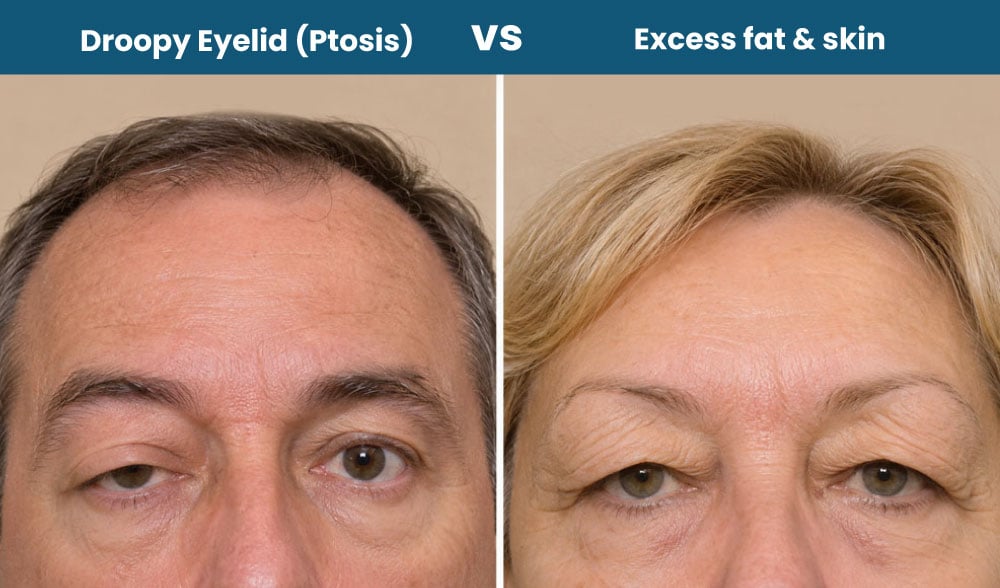
Someone with excess upper eyelid skin may appear to have droopy eyelids even when the eyelid margin is positioned normally. This is sometimes called pseudoptosis.

Learn More > Blepharoplasty

Side-by-side comparison of ptosis, showing a drooping upper eyelid, and excess upper eyelid skin commonly treated with blepharoplasty surgery.

What to Expect During Ptosis Surgery Recovery

1. The First 24 Hours

Most patients return home the same day. Mild discomfort, swelling, and bruising are common. Apply cold compresses and use prescribed medications as directed.

2. The First Week

Avoid rubbing your eyes, heavy lifting, and strenuous activities. Your eyelids may appear uneven as swelling improves.

3. Returning to Normal Activities

Many patients can resume light daily activities within approximately one week, depending on their recovery and surgeon’s recommendations.

4. Healing and Final Results

Swelling may take several weeks to improve, and final eyelid positioning can take longer to stabilize. Attend follow-up appointments and follow your surgeon’s instructions throughout your ptosis surgery recovery.

Woman applying a cold compress near her eye to help reduce swelling and discomfort during ptosis surgery recovery.

Schedule a Ptosis Surgery Consultation in Arizona

If a drooping upper eyelid is interfering with your vision or daily activities, an evaluation can help determine whether ptosis repair is appropriate. Schedule a consultation today to take the next step toward improving your eyelid function and field of vision.

Frequently Asked Questions: Ptosis Surgery

For adults with stable, mild ptosis that does not interfere with vision, observation may be appropriate. However, untreated ptosis can continue to obstruct your upper field of vision, cause forehead strain, or make activities such as reading and driving more challenging.

Depending on its underlying cause, ptosis may remain stable or gradually worsen.

A newly developed drooping eyelid, particularly when accompanied by double vision, a severe headache, unequal pupils, or other neurological symptoms, requires immediate medical evaluation.

Ptosis surgery typically costs between $2,000 and $10,000 per eyelid, but it varies depending on the technique, whether anesthesia is needed, surgical facility fees, and whether additional procedures are performed. Your total cost may also depend on whether the surgery is considered medically necessary or elective.


Following your evaluation, your surgical team can review your recommended procedure, estimated expenses, and available payment options.

Ptosis surgery insurance coverage may be available when a drooping eyelid causes documented functional impairment. For example, insurance may consider the procedure medically necessary when the upper eyelid obstructs your vision or significantly interferes with daily activities.

Insurance coverage is not guaranteed. Your benefits, medical necessity criteria, and potential out-of-pocket costs should be reviewed before surgery.

Possible complications include:

  • Eyelids that remain too low or are raised too high
  • Uneven eyelid height or contour
  • Bleeding, infection, or scarring
  • Difficulty completely closing the eyelid
  • Recurrence of ptosis
  • A need for additional corrective surgery
  • Corneal irritation or injury

Dry eye after eyelid surgery is an important consideration, particularly for patients who already experience dryness.

Raising the upper eyelid exposes more of the eye’s surface. If the eyelid does not close completely during healing, tears may evaporate more quickly, causing irritation, dryness, or blurred vision.

In some cases, inadequate eye protection can lead to corneal damage.

Dr. Evans or Dr. Moore will evaluate your tear film and eyelid closure before surgery and may recommend lubricating drops or additional treatment to protect your eyes afterward.

Some forms of ptosis may improve when an underlying medical condition is treated. Prescription eye drops may temporarily lift the eyelid in certain adults with acquired ptosis.

However, drops do not permanently repair stretched or weakened eyelid structures. Surgery is often the more definitive option for persistent structural ptosis.

Ptosis repair can provide long-lasting improvement, but results are not necessarily permanent. Age-related changes, muscle weakness, or other conditions may cause drooping to return over time.

Your upper eyelids will generally appear more elevated after surgery. Although improved symmetry is a goal, perfectly identical eyelids cannot be guaranteed.

Locations

855 South Dobson Road, Ste #1
Chandler, AZ 85224

Clinic & Optical Shop

5285 W Bell Rd
Ste. 110
Glendale, AZ 85308

Clinic & Optical Shop

1626 N. Litchfield Rd. Ste. 110
Goodyear, AZ 85395

Clinic & Optical Shop

5250 E. Southern Ave.
Mesa, AZ 85206

Clinic, Surgery Center, Optical Shop

4800 North 22nd St
Phoenix, AZ 85016

Clinic & Surgery Center

8763 E Bell Rd., Ste 106
Scottsdale, AZ 85260

Clinic & Surgery Center

14820 N. Del Webb Blvd.
Sun City, AZ 85351

Clinic, Surgery Center, Optical Shop

14239 W. Bell Rd.
Ste. 216
Surprise, AZ 85374

Clinic & Optical Shop

Doctors

William Evans, MD
William Evans, MD

Oculoplastics: Cosmetic & Reconstructive Surgeon, Ophthalmologist

Grant Moore, MD
Grant Moore, MD

Oculoplastics: Cosmetic & Reconstructive Surgeon, Ophthalmologist