

A Christmas tree cataract is a rare type of cataract that creates multicolored, reflective crystals inside the eye’s natural lens. Under magnification, these tiny deposits can shimmer in shades of red, green, blue, gold, and white, giving the cataract a look like lights or tinsel on a Christmas tree.
The name may sound festive, but a Christmas tree cataract is still a change within the natural lens. Some people have few noticeable symptoms, while others develop blurry vision, glare, faded colors, or difficulty seeing clearly at night.
At Barnet Dulaney Perkins Eye Center, patients across Arizona can receive a detailed cataract evaluation to determine whether sparkling lens deposits, a more common cataract, or another eye condition is affecting their vision.
Schedule a cataract evaluation to find out what may be affecting your vision.
What Is a Christmas Tree Cataract?
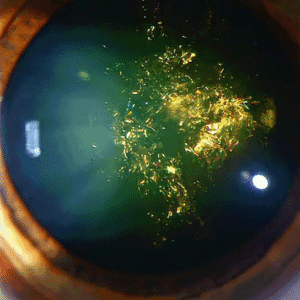
Christmas tree cataracts contain highly reflective, needle-shaped deposits that cross through portions of the lens. As light reaches the deposits from different angles, they can appear to change color or sparkle. Published clinical reports describe these cataracts as containing polychromatic crystals within the lens cortex and nucleus.
An eye doctor usually sees the colorful effect during a slit lamp examination. It may not be obvious when someone casually looks into the patient’s eyes, and the patient may not literally see colored sparkles in their own vision.
Why Do the Crystals Form?
Researchers have connected the shimmering appearance to changes in proteins and amino acids inside the aging lens. As lens material breaks down, concentrated deposits may crystallize and reflect light in different colors.
Christmas tree cataracts are rare and most often reported in older adults. Similar multicolored lens changes have also been observed in some people with myotonic dystrophy, a genetic condition that affects muscles and other body systems. However, seeing a Christmas tree cataract does not automatically mean a person has myotonic dystrophy. An eye doctor can review the patient’s health history and recommend additional medical evaluation when appropriate.
Do Christmas Tree Cataracts Affect Vision?
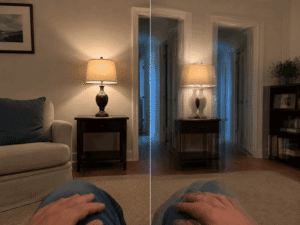
Vision changes depend on the crystals’ size, density, and location, as well as any other cataract changes in the lens. Symptoms may include:
- Blurry, cloudy, or hazy vision
- Glare from sunlight, lamps, or headlights
- Halos or starbursts around lights
- Difficulty driving at night
- Reduced contrast in dim conditions
- Faded or yellowed colors
- Double vision in one eye
- Frequent glasses prescription changes
- Needing brighter light to read
These symptoms overlap with more common age-related cataracts. A comprehensive examination is the only reliable way to identify which type of cataract is present and determine whether another condition also affects vision.
Patients who want a broader explanation can review what cataracts are and how they affect vision.
How an Eye Doctor Identifies the Sparkle
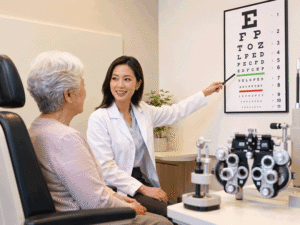
Depending on the patient’s symptoms and eye health, a cataract evaluation may also include:
- Visual acuity testing
- Refraction to check the glasses prescription
- Glare or contrast testing
- Eye pressure measurement
- Dilated examination of the retina and optic nerve
- Corneal measurements
- Imaging or additional testing when another condition may be present
- Detailed measurements for cataract surgery planning
The evaluation also helps the doctor determine whether the cataract explains the patient’s vision concerns. Dry eye, glaucoma, macular degeneration, corneal disease, and diabetic eye disease can also contribute to glare, blur, or poor night vision.
Cataract Surgery Removes the Sparkling Natural Lens
Cataract surgery is the only treatment that removes a Christmas tree cataract. During the procedure, the surgeon removes the cloudy natural lens, including the colorful crystalline deposits, and replaces it with a clear artificial intraocular lens.
The crystals do not remain behind inside the eye once the affected natural lens has been removed. This is true regardless of which appropriate replacement lens the patient and surgeon select.
Whether the surgeon uses a basic or laser-assisted cataract procedure, the goal is to remove the affected natural lens and replace it with an appropriate intraocular lens.
Surgery may not be necessary simply because the cataract looks unusual. The decision usually depends on whether vision changes interfere with reading, driving, work, hobbies, safety, or independence.
Patients who are unsure about timing can explore when to consider cataract surgery.
If cataract surgery is recommended, review how to prepare for cataract surgery and answers to common cataract surgery questions before your procedure.
Where the Light Adjustable Lens Fits In
The Light Adjustable Lens does not uniquely remove the Christmas tree sparkle. Cataract surgery removes the sparkle by taking out the affected natural lens.
What makes the Light Adjustable Lens different is what happens after the new lens is implanted.
Traditional intraocular lenses have a fixed focusing power selected before surgery. The Light Adjustable Lens is made of photosensitive material that allows an eye doctor to adjust its focusing power after the eye has begun healing. Controlled ultraviolet light treatments can fine-tune the patient’s prescription based on how the eye actually sees following surgery.
This option may appeal to eligible patients who want:
- Vision customized after surgery
- Greater precision based on the healed eye
- Correction of qualifying residual astigmatism
- Less dependence on glasses for selected activities
- The ability to test their vision before the final prescription is locked in
The Light Adjustable Lens is not right for every patient. Eye health, medications, macular health, lifestyle, ability to attend adjustment visits, and willingness to follow ultraviolet-protection instructions all matter.
Learn more about Light Adjustable Lens cataract surgery in Arizona and how vision can be customized after cataract surgery.
Comparing Cataract Lens Options
Removing the Christmas tree cataract and choosing the replacement lens are related but separate decisions.
| Lens Option | Primary Consideration |
| Monofocal lens | Focuses mainly on one selected distance |
| Toric lens | Addresses eligible corneal astigmatism |
| Multifocal or trifocal lens | Provides multiple focal zones for a broader range of vision |
| Extended-depth-of-focus lens | Extends the range of focus, often emphasizing distance and intermediate vision |
| Light Adjustable Lens | Allows the prescription to be adjusted after surgery |
No single lens is best for everyone. The right option depends on eye health, prior eye surgery, astigmatism, reading habits, night-driving needs, budget, and the patient’s comfort with glasses.
Barnet Dulaney Perkins Eye Center provides a full guide to cataract surgery lenses so Arizona patients can begin comparing their options before a consultation.
Review cataract surgery costs in Arizona as you compare your procedure and lens options.
Recovery After the Sparkling Cataract Is Removed
Once the natural lens has been removed, the Christmas tree crystals cannot regrow because the lens is no longer present. However, patients still need time for the eye to heal and adjust to the new intraocular lens. Vision may fluctuate during the first days or weeks. Patients should use prescribed drops, protect the eye, avoid rubbing it, and attend all follow-up visits.
Patients receiving the Light Adjustable Lens also need several adjustment and lock-in appointments. Protective ultraviolet-blocking glasses must be worn as instructed until the lens adjustments are complete.
Review the cataract surgery recovery timeline for practical guidance on driving, exercise, screen time, showering, and follow-up care.
See What Is Causing Changes in Your Vision
A Christmas tree cataract may produce an unforgettable sparkle during an eye examination, but what matters most is how well you can see and whether the lens change affects daily life.
At Barnet Dulaney Perkins Eye Center, our cataract doctors can evaluate your vision and discuss treatment and lens options. Request a cataract evaluation or download our cataract guide to learn more.