

Blurry vision can make objects appear hazy, distorted, or out of focus at one or more distances. Common causes include refractive errors, dry eye, cataracts, eye floaters, medication side effects, and changes in blood sugar levels. Sudden blurry vision can also signal a condition that needs immediate medical attention.
The timing and pattern of your symptoms matter. Gradually developing blurry vision may indicate a changing prescription or an age-related condition. Vision that suddenly becomes blurry, especially in one eye, with flashes, floaters, pain, weakness, or a dark shadow, should be evaluated promptly.
If blurry vision is affecting your daily activities, schedule an eye exam with Barnet Dulaney Perkins Eye Center. Our Arizona eye doctors can identify the cause and recommend appropriate treatment.
When Is Blurry Vision an Emergency?
Seek immediate medical care if blurry vision begins suddenly or occurs with:
- Sudden vision loss in one or both eyes
- A dark curtain, veil, or shadow in your vision
- A sudden increase in floaters or flashes of light
- Severe eye pain or redness
- A severe headache, nausea, or halos around lights
- Facial drooping, weakness, numbness, confusion, or difficulty speaking
- Blurry vision following an eye injury
- Double vision that begins suddenly
These symptoms may be associated with a retinal detachment, acute glaucoma, stroke, eye injury, or another condition requiring prompt treatment.
Barnet Dulaney Perkins Eye Center provides emergency eye care in Arizona. Call 911 for symptoms that may indicate a stroke or another life-threatening emergency.
Blurry Vision in One Eye Versus Both Eyes
Blurry vision in one eye may result from a refractive difference, dry eye, cataract, retinal condition, corneal problem, or an issue involving the optic nerve or blood vessels. Sudden blurry vision in one eye warrants prompt attention, particularly when accompanied by flashes, floaters, pain, or a shadow in the visual field.
Blurry vision in both eyes can occur with refractive errors, dry eye, medication effects, migraine, digital eye strain, or changes in blood sugar. The number of affected eyes does not determine the severity of the problem. The timing, accompanying symptoms, and underlying cause matter most.
Myopia
Myopia, better known as nearsightedness, is one of the most common refractive eye errors. Nearsighted people can see well up close but have difficulty seeing distant objects clearly. Myopia symptoms may include:
- Blurry vision when looking at distant objects
- Excessive blinking and squinting
- Headaches caused by eye strain


What causes myopia?
Myopia occurs when light focuses in front of, instead of on, the retina. Light entering the eye isn’t focused correctly, causing distant objects to look hazy. While the exact cause is unknown, evidence suggests that nearsightedness may be inherited. Individuals who experience significant eye strain from working at a computer or performing other close visual work may also be more likely to develop myopia.
How is nearsightedness treated?
Myopia is commonly corrected with glasses or contact lenses. Depending on your prescription, eye health, and goals, LASIK or another vision correction procedure may also reduce your dependence on corrective lenses.
Hyperopia

If you only experience fuzzy vision up close, you may have hyperopia, also known as farsightedness. In cases of severe hyperopia, distant objects may also appear blurry. Hyperopia symptoms may include:
- Foggy vision when looking at nearby objects
- You need to squint to see distant or nearby objects clearly
- Headaches caused by eye strain
What causes hyperopia?
Farsightedness occurs when light rays focus beyond the retina rather than on it, making near objects appear blurry. Like myopia, farsightedness is usually inherited.
How is farsightedness treated?
Glasses, contact lenses, or refractive surgery can correct farsightedness. An eye exam can determine which option is appropriate for your prescription and eye health.
Astigmatism
Astigmatism is another standard refractive error in the family of nearsightedness and farsightedness. People with astigmatism generally have fuzzy vision at all distances. Astigmatism symptoms may include:
- Nearby and distant objects appear blurry or distorted
- You need to squint to see clearly
- Headaches caused by eye strain
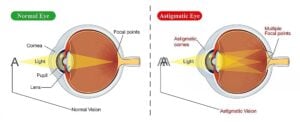
What causes astigmatism?
Astigmatism is the result of an irregular curvature of the cornea or lens. Most people are born with astigmatism, though it can also develop due to eye disease, injury, or surgery.
How is astigmatism treated?
Astigmatism can be corrected with glasses, contact lenses, or certain vision correction procedures. The appropriate treatment depends on the type and degree of astigmatism and the overall health of the cornea.
Presbyopia

Presbyopia is the gradual loss of near-focusing ability. This condition is a normal part of the aging process; most people begin to notice the effects of presbyopia shortly after age 40. The effects of presbyopia are similar to the symptoms of farsightedness:
- Blurry vision up close
- Squinting at a normal reading distance
- Headaches or fatigue from eye strain
What causes presbyopia?
Although presbyopia is often confused with farsightedness, the causes are different: Presbyopia occurs when the lens loses flexibility with age, whereas a misshapen eyeball or cornea causes farsightedness. Presbyopia is also part of aging, whereas farsightedness is typically an inherited vision problem.
How is presbyopia treated?
Reading glasses, prescription glasses, multifocal contact lenses, and certain vision correction procedures may help manage presbyopia. Schedule an eye exam before relying on over-the-counter readers so your doctor can check each eye, determine the correct strength, and rule out other causes of near-vision changes.
Chronic Dry Eyes
A healthy tear film helps create clear, stable vision. When the eyes do not produce enough tears or the tears evaporate too quickly, vision may become intermittently blurry.
Dry eye symptoms may include:
- Blurry or fluctuating vision
- Burning or stinging
- Redness
- A gritty or scratchy feeling
- Watery eyes
- Sensitivity to light
- Discomfort when wearing contact lenses
Dry eye can develop because of age, medications, environmental conditions, prolonged screen use, hormonal changes, inflammation, or problems with the oil glands in the eyelids.
Treatment depends on the cause and severity of the condition. Options may include artificial tears, prescription eye drops, punctal plugs, eyelid treatments, or in-office therapy. Learn more about dry eye treatment at Barnet Dulaney Perkins Eye Center.
Eye Floaters

Eye floaters are another age-related cause of blurry vision. Microscopic fibers within the eye’s jelly-like vitreous layer clump together and cast tiny shadows on your retina, which may appear as gray specks, cobwebs, strings, or other floating aberrations. Symptoms of eye floaters include:
- Spots in your vision that appear as dark spots or transparent, floating material
- Spots that move quickly out of your visual field when you try to look at them
- Spots that appear with eye movement and then settle down and drift out of the line of vision
What causes eye floaters?
Eye floaters most commonly result from age-related changes in the vitreous. The sudden appearance of eye floaters may also signal a more serious eye problem, such as posterior uveitis (inflammation in the back of the eye) or retinal detachment.
How are eye floaters treated?
Many eye floaters do not require treatment after an eye doctor confirms that the retina is healthy. Some become less noticeable as they move away from the center of vision or as the brain adapts to them.
Treatment may be considered when floaters significantly interfere with vision and daily activities. In carefully selected cases, a retina specialist may discuss procedures such as vitrectomy. Every procedure carries potential risks, so treatment decisions require a detailed retinal examination.
A sudden increase in floaters, flashes of light, blurry vision, or a curtain-like shadow may indicate a retinal tear or retinal detachment and requires immediate evaluation.
Other Causes of Blurry Vision
Blurry vision can also result from conditions affecting the lens, retina, optic nerve, cornea, or blood vessels inside the eye.
Cataracts
Cataracts develop when the natural lens becomes cloudy. They commonly cause gradually worsening blurry vision, faded colors, glare, halos, and difficulty seeing at night.
Glaucoma
Most forms of glaucoma develop without noticeable early symptoms. However, acute angle-closure glaucoma can cause sudden blurry vision, intense eye pain, redness, headache, nausea, and halos around lights. These symptoms require immediate medical attention.
Macular Degeneration
Macular degeneration affects central vision and may cause blurriness, distortion, difficulty recognizing faces, or a dark or empty area near the center of your sight.
Diabetic Eye Disease
Changes in blood sugar can temporarily affect the shape of the eye’s lens and cause blurry vision. Over time, diabetes can also damage retinal blood vessels and lead to diabetic retinopathy or diabetic macular edema.
People with diabetes should receive regular dilated eye exams, even when their vision appears normal. Learn more about diabetic eye care.
Find the Cause of Your Blurry Vision
Blurry vision has many possible causes, and symptoms alone may not reveal which condition is responsible. A comprehensive eye exam can evaluate your prescription, tear film, cornea, lens, retina, optic nerve, and other structures that affect clear vision.
Barnet Dulaney Perkins Eye Center provides comprehensive eye care throughout Arizona. If your vision has become blurry, hazy, or difficult to focus, schedule an eye exam online or call (602) 955-1000.