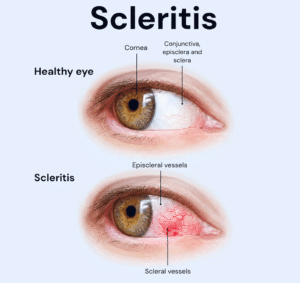
What is scleritis? Scleritis is inflammation of the sclera, the white outer layer of the eye. It can cause deep eye pain, redness, tenderness, light sensitivity, and blurry vision. Unlike a mildly irritated eye, scleritis can become serious and should be evaluated by an eye doctor, especially when pain is intense, vision changes, or redness does not improve.
The sclera provides the eye with structure and helps protect the delicate tissues inside. When this layer becomes inflamed, the eye may look red or purple-red and feel sore, tender, or deeply painful.
Scleritis may affect the front of the eye (anterior scleritis) or the back of the eye (posterior scleritis). Anterior scleritis is more common. Posterior scleritis can be harder to recognize because it may cause pain, headache, blurry vision, or changes inside the eye without the same obvious surface redness.
Symptoms Of Scleritis
Scleritis symptoms can vary, but they often feel more intense than routine eye irritation.
Headache or pain around the brow, temple, cheek, or jaw
If you have sharp or severe eye pain, this related guide onstabbing eye pain can help explain why prompt evaluation matters. If your main symptom is vision change, the guide toblurry vision causes and treatment may also help with the next step.
Scleritis Vs. Episcleritis
Scleritis and episcleritis can both make the eye look red, but they are not the same condition. Episcleritis affects a more superficial layer of tissue and often causes milder discomfort. Scleritis involves deeper inflammation and may cause more severe pain, tenderness, and possible vision changes.
Because the two can look similar at home, do not try to diagnose the difference by appearance alone. An eye doctor may use a slit-lamp exam, history of symptoms, eye pressure testing, dilation, imaging, or other tests to determine which layer of the eye is inflamed.
What Causes Scleritis?
Sometimes scleritis has no clear cause. In other cases, it may be linked to an autoimmune or inflammatory condition such as rheumatoid arthritis, lupus, inflammatory bowel disease, or certain forms of vasculitis. Less commonly, scleritis may follow infection, trauma, or eye surgery.
That connection matters because treatment may need more than eye drops. Your eye doctor may ask about joint pain, rashes, digestive symptoms, recent illness, surgery history, or known autoimmune disease. In some cases, your care may involve coordination with your primary care provider or a rheumatologist.
How Scleritis Is Diagnosed
Diagnosis starts with an eye exam and a detailed history of symptoms. Your doctor may check visual acuity, intraocular pressure, the front of the eye (the sclera and cornea), and the inside of the eye after dilating your pupils.
Retinal evaluation when vision changes are present
Imagine if posterior scleritis is suspected
Lab testing when autoimmune or infectious causes are possible
Because scleritis can overlap with corneal, retinal, and pressure-related concerns, your doctor may also consider related care pathways such ascornea care,retina care, orglaucoma treatment when symptoms or exam findings point that direction.
Scleritis Treatment Options
Scleritis treatment depends on the cause, severity, and whether the inflammation affects the front or back of the eye. Your doctor’s first goal is to reduce inflammation, relieve pain, protect vision, and identify any underlying health conditions.
Treatment may include oral anti-inflammatory medication, prescription eye medication, oral corticosteroids, immunomodulating medication, or treatment for infection when present. More severe, recurrent, posterior, or vision-threatening cases may need closer monitoring and coordination with another medical specialist.
Do not use leftover prescription drops or start someone else’s medication for a painful red eye. Some conditions can worsen without the right diagnosis.
When To Call An Eye Doctor
Schedule care promptly if you notice a painful red eye, especially if the pain feels deep, keeps you awake, worsens with eye movement, or comes with light sensitivity. This guide tophotophobia and light sensitivity explains why light sensitivity can point to inflammation or another eye condition.
Call right away or seek urgent care if you have severe eye pain, sudden vision loss, new floaters or flashes, eye trauma, chemical exposure, or rapidly worsening redness and swelling.
Get Help For A Painful Red Eye In Arizona
A red, painful eye should not be a guessing game. Barnet Dulaney Perkins Eye Center can evaluate eye pain, redness, light sensitivity, and vision changes across Arizona. If you are concerned about scleritis or another inflammatory eye condition,schedule online or call 602-955-1000 to determine the next best step.
FAQ: What Is Scleritis?
Yes, scleritis can be serious. It involves inflammation of the sclera and may affect vision, especially when it is severe, recurrent, posterior, or associated with another health condition.
Scleritis pain often feels deep, aching, boring, or tender. Some people notice pain with eye movement or pain that spreads toward the head, temple, brow, cheek, or jaw.
Yes, scleritis can cause blurry or decreased vision, especially if inflammation affects nearby eye structures. Any painful red eye with vision changes should be evaluated promptly.
Scleritis affects deeper tissue and usually causes more severe pain, tenderness, and possible vision changes. Episcleritis affects a more superficial layer and often causes milder irritation, but an exam is needed to distinguish it from episcleritis.
Scleritis may be linked to autoimmune disease, inflammation elsewhere in the body, infection, trauma, prior eye surgery, or no clear cause. Your eye doctor may recommend additional testing if an underlying condition is possible.
Scleritis treatment depends on the cause and severity. Treatment may include oral anti-inflammatory medication, prescription eye medication, corticosteroids, immunomodulating medication, treatment for infection, or coordinated care with another specialist.
Yes. A painful red eye should be checked, especially if pain is deep, severe, worsening, or accompanied by light sensitivity, blurry vision, injury, discharge, headache, floaters, or flashes.
Yes. Barnet Dulaney Perkins Eye Center can evaluate painful red eyes, signs of inflammation, light sensitivity, and vision changes. An eye exam can help determine whether symptoms are due to scleritis or another eye condition.
Related Posts
Schedule an Eye Health Check-Up Online
Our experienced eye doctors provide comprehensive care for patients of all ages, from updating prescriptions to diagnosing and managing eye conditions. Schedule your eye exam today and take the next step toward clearer vision and healthier eyes.
To provide the best experiences, we use technologies like cookies to store and/or access device information. Consenting to these technologies will allow us to process data such as browsing behavior or unique IDs on this site. Not consenting or withdrawing consent, may adversely affect certain features and functions.
Functional
Always active
The technical storage or access is strictly necessary for the legitimate purpose of enabling the use of a specific service explicitly requested by the subscriber or user, or for the sole purpose of carrying out the transmission of a communication over an electronic communications network.
Preferences
The technical storage or access is necessary for the legitimate purpose of storing preferences that are not requested by the subscriber or user.
Statistics
The technical storage or access that is used exclusively for statistical purposes.The technical storage or access that is used exclusively for anonymous statistical purposes. Without a subpoena, voluntary compliance on the part of your Internet Service Provider, or additional records from a third party, information stored or retrieved for this purpose alone cannot usually be used to identify you.
Marketing
The technical storage or access is required to create user profiles to send advertising, or to track the user on a website or across several websites for similar marketing purposes.